
The Indigenist Model
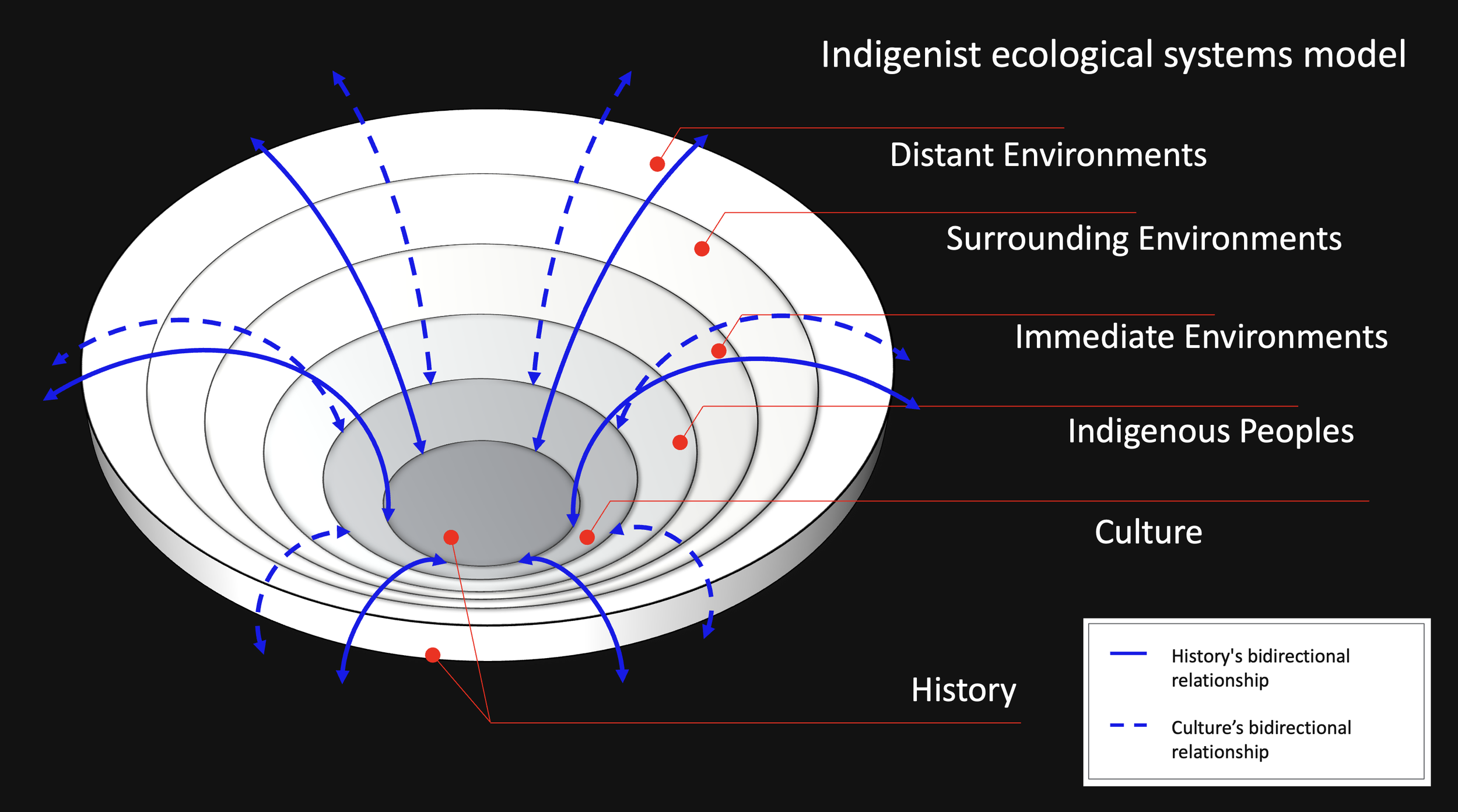

A framework for Indigenous well-being
The Indigenist Model is a relational framework for understanding Indigenous well-being through Indigenous ways of knowing. Developed through research, community engagement, and lived experience, the model asks what changes when we center history, land, kinship, and cultural strengths in conversations about health and healing?
Rather than isolating individuals from their social and historical contexts, the Indigenist Model situates well-being within collective memory, ongoing colonial conditions, and enduring cultural continuity. It holds both truths: that Indigenous communities carry the weight of dispossession and rupture, and that they also carry knowledge, resilience, and relational strength that persist across generations.
Healing, in this framework, is not only about addressing harm. It is about restoring and strengthening relationships — to self, to family, to community, to culture, and to land.
A Strenghs-Based Approach
While many dominant health frameworks focus primarily on risk and pathology, the Indigenist Model emphasizes balance. It recognizes historical and intergenerational trauma, but it also foregrounds protective factors including cultural identity, kinship networks, traditional knowledge, ceremony, and community-defined pathways to wellness.
By centering Indigenous epistemologies, the model reframes well-being as relational rather than individual, collective rather than isolated, and grounded in strengths rather than deficits.
The Indigenist Model was first articulated through my published work and continues to evolve in conversation with community knowledge. It has been shared nationally, including through my TEDx talk with TEDxMinneapolis.
The model also serves as the guiding framework for a five-year, $12 million P50 Center of Excellence award from the National Institutes of Health’s National Institute on Drug Abuse at Johns Hopkins Center for Indigenous Health. This work applies the Indigenist model in partnership with Indigenous communities to advance culturally grounded approaches to addressing substance use-related health concerns.
While grounded in academic research, the Indigenist Model is not confined to institutional settings. It remains accountable to the communities and relational teachings from which it emerged.
Scholarship in
Practice
The CIRCLE P50 Center of Excellence at Johns Hopkins Center for Indigenous Health is funded by the National Institute On Drug Abuse of the National Institutes of Health under Award Number P50DA058619.
The Indigenist Model is not a fixed theory. It is a living framework that invites dialogue about how Indigenous knowledge can guide research, policy, and practice in ways that honor collective care and cultural continuity.
If you are interested in learning more, collaborating, or bringing this framework into your organization or community space, I welcome conversation.